

The Underdog: How Growth Mindset can support your Career Development
)
It is common in the veterinary industry for us to be dead set on hierarchy and career progression. There is a clear pathway in veterinary nursing, for example. You start as a veterinary care assistant with little animal experience, become a student nurse, and then qualify as one. You might then step into referral practice, then up to a lead nurse position. That is the pathway that is expected.
When I started as a veterinary care assistant, I did not star in the typical prequel or trilogy of this career story. I came in as an experienced animal handler, trainer and educator (birds of prey mostly, but I digress...) wanting to become a clinical animal behaviourist. I baffled some people, because I challenged what was considered the professional norm.
Within my role as a VCA at a busy referral practice, I quickly found myself applying my skills in different ways and building a bit of a niche for myself. I implemented and managed our practice bereavement protocol and became the practices’ first VCA mentor. I also dabbled in public engagement on the side, when I wasn’t scrubbing the skirting board with a toothbrush. When I finished my MSc in Clinical Animal Behaviour, I was ready to move forward, but I ended up in a direction I wasn’t quite expecting. I am now the Education and Development Officer of my practice, pioneering a brand-new role supporting the main hospital and our branch practices. Safe space here... I felt like an absolute imposter. Who was I to be running such an important department? I was barely out of my burgundy scrubs!
I look at similar roles to mine, and I see the job description calling for an experienced veterinary surgeon or veterinary nurse with a background in education to do my job, and this, quite honestly, astounds me. You don’t need a veterinary degree or qualification to be a good educator, to be a good coach. My background constantly surprises people, and to be honest I am glad. The progression into my role is important to talk about, because if we keep seeing people as nothing but their job title, we are missing a vital opportunity to expand and develop our business, and our industry. We risk losing people of great skill and value, and keeping people in very narrow boxes which can end in them losing their curiosity to explore different avenues.
So, where is this leading? Well, we can’t get the best out of ourselves, or our team, without development. Now, the term growth mindset is flung around regularly, and to be honest up until a couple of months ago, I didn’t really know what it meant or how it applied to me. So, let’s look at this concept briefly.
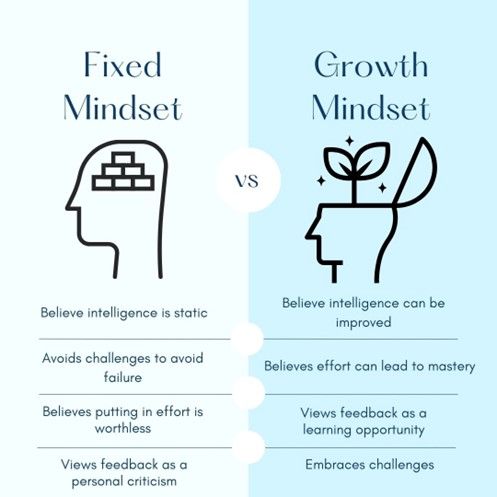
Don’t get me wrong, there is more to unpack about the subject than this simple graphic suggests, but it gives you a quick overview of what is a massive concept. The concept itself was coined by Dr Caroline Dweck, when investigating why some people failed and others succeeded. This concept has now become widely spread amongst education and business growth, but I think it is important to recognise at this point that you are never of one mindset. You may be more inclined to one side of the coin, but this is influenced by numerous factors including the context, your upbringing, your values and your past experiences.
So, big question; how can you utilise growth mindset to help you develop?
1. Understand that you can improve.
Science says so. Our brains are built to learn, form new pathways and grow. By opening yourself up to new experiences, and repeating exposure to these, you can start to strengthen new neural pathways. Deliberate practice will lead to improvements in performance, regardless of initial talent levels.
2. Challenge your inner critic.
We all have the little gremlin inside us that regularly tells us “You can’t do that, you’re not smart enough.” You can’t get rid of them, but you can call them out with curiosity. Look at some sneaky language changes to help you out, instead of thinking “I can’t do this”, say “I can’t do this, yet.”
3. Celebrate the journey.
As an industry we are very fixed on outcomes, but this risks missing the bigger picture when it comes to personal development. Focusing on the effort you have made on your journey, and championing this can help empower you to grow further! Again, look at that language. “I haven’t achieved that goal, I have failed”. How about “I haven’t achieved that goal yet; I am learning and will keep working at it!”
4. Feedback is your friend.
When you are told about something you have done well, it motivates you to keep going, right? It is that basic positive reinforcement training style. The extra bonus of feedback is it allows us time to reflect on our challenges and growth points going forward. There will always be areas we can improve on, but likewise there will always be something to celebrate.
5. Push yourself out of your box!
Being brave enough to come out of your comfort zone or push yourself out of the societal norm your role as placed you in is inherently uncomfortable, but in just being brave enough to challenge this you can foster a growth mindset. Know that sometimes it will be hard, but if everything was easy and comfortable, we wouldn’t develop!
6. Accept failure.
It’s part of learning! If every task or experience was plain sailing our brain would be as smooth as an egg. When trying something new, start trying to reframe failure as an opportunity to learn, it's part of the process and it will always give you something to go forward. It may be difficult to find a path forward sometimes, and that is okay. It’s totally normal to stop and re-consider how you move forward after a failure, but be curious. Talk to people, think about feedback, how can these things help you get to the next step.
To summarise with a personal tangent... I was asked to speak about this topic later in the year. Imposterism snuck in. Who am I to talk about this? I am not a neuroscientist, or a psychologist, how will the musings of an education officer and behaviourist benefit anybody? So, instead of hiding away from the challenge, I took it up. I then sought out some advice and feedback from a friend. He didn’t give me the answer, but he helped me find one. I wasn’t asked to talk about this subject because of my academic experience, but my personal one. My personal and professional journey oozes this concept, and that is what helps me talk about it. My job now is focused on empowerment of my colleagues, so I hope this article has done that for you too. My biggest bit of advice? Stay curious.


)
)
)
)
)
)
)
)
)
)
)
)
)
)
)
)
)
)